Wallpaper: the art of transforming a wall into a statement
- PENTAGON DECORATORS
- Jun 19
- 4 min read

Paint has its place. But when you want a wall to truly speak — to carry texture, depth, pattern, and personality — nothing rivals wallpaper. From ancient Chinese silk hangings to today's high-definition digital prints, wallpaper has endured as one of the most powerful and versatile tools in interior design. Here is everything you need to know.
A brief history
Wallpaper dates back to 16th-century Europe, when hand-painted and woodblock-printed papers were coveted by royalty and aristocrats as an affordable alternative to tapestries. By the 18th century, advances in printing made wallpaper accessible to the middle class, and it quickly became a defining feature of interior decoration across the world.
Today, wallpaper has evolved far beyond its origins. Modern manufacturing techniques have produced materials that are waterproof, washable, fire-resistant, and even acoustic — making wallpaper as practical as it is beautiful.
Categories of wallpaper
The wallpaper market is rich and varied. Choosing the right type is as important as choosing the right design. Here is a comprehensive guide to the major categories.
Vinyl wallpaper
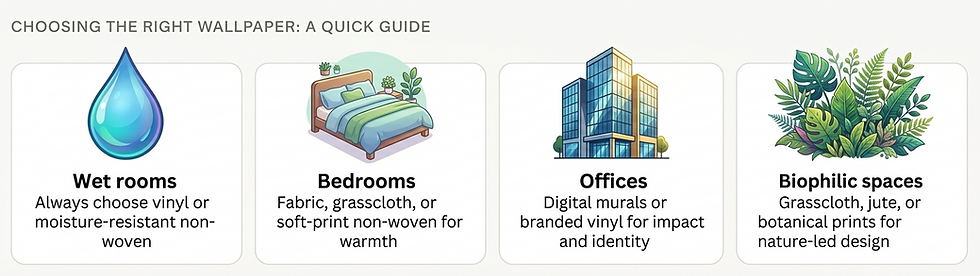
The most popular wallpaper type globally, vinyl wallpaper consists of a paper or fabric base coated with PVC (polyvinyl chloride). It is highly durable, water-resistant, and easy to clean — making it the go-to choice for kitchens, bathrooms, and high-traffic areas like hallways and children's rooms. It is available in smooth finishes, embossed textures, and metallic effects.
Best for: kitchens, bathrooms, hallways, commercial spaces
Non-woven wallpaper
Made from a blend of natural and synthetic fibres, non-woven wallpaper is breathable, tear-resistant, and dimensionally stable — meaning it does not expand or contract with moisture. It is one of the easiest wallpapers to hang and remove, as it can be stripped dry in single sheets. Interior designers and professionals frequently recommend it for its ease of installation and premium finish.
Best for: living rooms, bedrooms, feature walls, professional installations
Fabric wallpaper
Fabric wallpaper uses textiles — linen, silk, cotton, jute, or synthetic blends — backed with paper or acrylic. It introduces a warmth and tactile richness that no printed surface can replicate. Silk fabric wallpaper, in particular, is synonymous with luxury interiors, catching light in ways that shift the entire mood of a room throughout the day.
Best for: luxury bedrooms, private lounges, premium hotel interiors
Grasscloth & natural fibre wallpaper
Woven from natural plant materials — seagrass, jute, sisal, bamboo, or reed — and mounted on a rice paper backing, grasscloth wallpaper brings organic texture and an earthy sophistication to interiors. Each roll is subtly unique, giving walls a handcrafted quality. It is particularly popular in biophilic design and in spaces seeking a connection to nature.
Best for: dining rooms, studies, eco-conscious interiors, feature walls
Digital / custom printed wallpaper
Perhaps the most exciting category in modern wallpaper design, digitally printed wallpaper allows for fully bespoke, photorealistic imagery at any scale. Murals of cityscapes, forests, abstract art, brand graphics, and family photographs can all be reproduced with stunning accuracy on wall surfaces. This type is increasingly popular in both residential interiors and corporate brand environments.
Best for: accent walls, commercial spaces, branded environments, statement interiors
3D & textured wallpaper
3D wallpaper uses embossing, moulded foam, or structural panels to create surfaces with genuine physical depth — mimicking brick, stone, wood, concrete, geometric tiles, and abstract sculptural forms. It adds dimension to flat walls and is especially effective in feature wall applications where a single surface needs to anchor the entire room's visual identity.
Best for: living rooms, feature walls, modern and contemporary interiors
Peel-and-stick wallpaper
The rising favourite of renters, students, and those who love frequent refreshes — peel-and-stick wallpaper uses a self-adhesive backing that applies cleanly to smooth walls and removes without damage. While it does not match the longevity of traditional wallpapers, it has improved dramatically in texture, print quality, and adhesion. An ideal option for temporary spaces and quick transformations.
Best for: rental apartments, nurseries, accent walls, seasonal updates
Why wallpaper is the finest wall covering choice
01 Unmatched design versatility
No other wall covering offers the sheer breadth of design possibilities that wallpaper does. From delicate botanical prints and geometric patterns to bold murals and metallic abstracts — wallpaper can achieve any aesthetic in any room. Paint is limited to colour; wallpaper delivers colour, pattern, texture, and depth simultaneously.
02 Texture and tactile richness
Walls covered in textured wallpaper — whether grasscloth, embossed vinyl, or fabric — engage the senses in ways that paint simply cannot. Texture catches light differently at various times of day, giving a room a living, dynamic quality that elevates the entire interior experience.
03 Durability that outlasts paint
Quality wallpaper, properly installed, can last 10 to 15 years — far longer than the average paint job, which typically requires reapplication every 3 to 5 years. Vinyl and non-woven wallpapers are washable, scuff-resistant, and hold their colour without fading under normal conditions.
04 Hides wall imperfections beautifully
Uneven plaster, hairline cracks, pitting, and surface irregularities that would show plainly under a coat of paint are effectively concealed by wallpaper. Textured and embossed options are particularly effective at disguising older or imperfect wall surfaces, saving costly remediation work.
05 Adds perceived depth and dimension
The right wallpaper pattern can visually alter the proportions of a room. Vertical stripes draw the eye upward and make ceilings feel higher. Large-scale patterns make compact rooms feel more expansive and interesting. Horizontal patterns can widen a narrow space. Wallpaper is, in this sense, a form of architectural illusion.
06 Acoustic benefits
Fabric and non-woven wallpapers have measurable sound-dampening properties, absorbing echo and reducing noise transmission between rooms. This makes them particularly valuable in home offices, media rooms, open-plan offices, and hospitality environments where acoustic comfort matters.
07 Instantly transforms a space
Few interventions in interior design deliver as dramatic and immediate a transformation as wallpaper. A single feature wall covered in the right paper can redefine the entire personality of a room — changing its mood, scale, and story in a way that furniture rearrangements or accessory changes never could.
08 A sustainable choice
Modern wallpapers increasingly use water-based inks, recycled content, and sustainably sourced natural fibres. Because they last significantly longer than paint, they also reduce the frequency of redecorating — and the waste and disruption that comes with it. For the environmentally conscious homeowner or designer, wallpaper has become a genuinely responsible choice.
Wallpaper does not just cover a wall. It completes a room — giving it the final layer of character, warmth, and intention that makes a space feel truly designed rather than merely decorated.

Comments